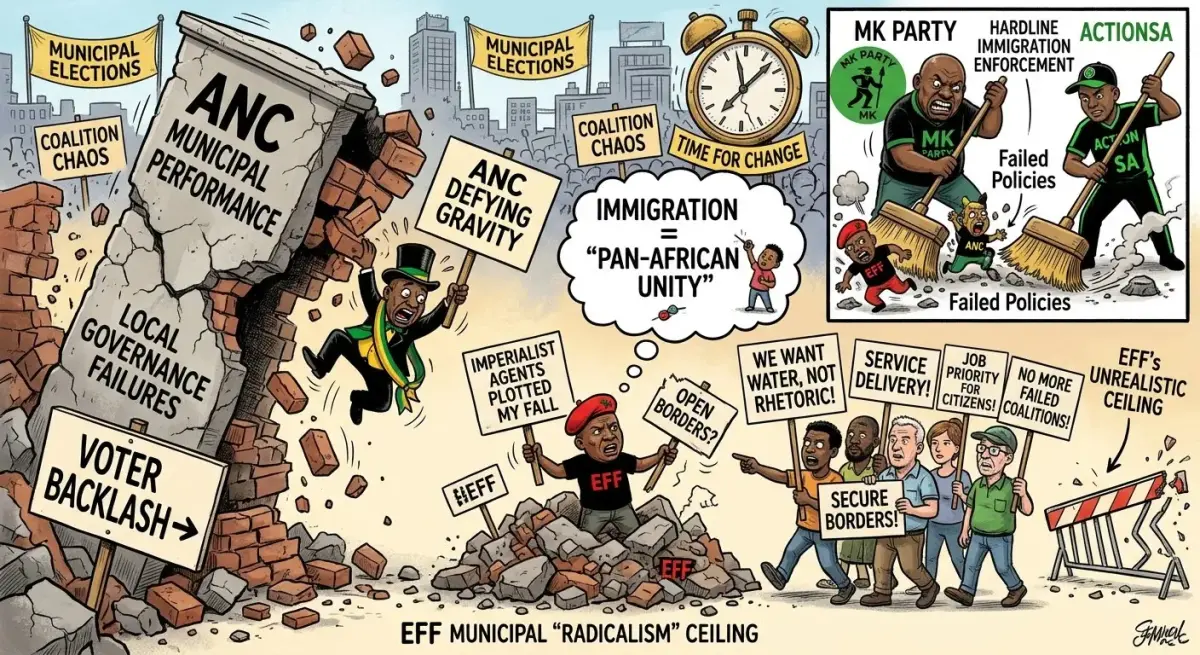
The African National Congress (ANC) and Economic Freedom Fighters (EFF) suffered heavy losses in the 4 November 2026 local government elections. Final results from the Independent Electoral Commission confirmed the ANC at 30.76% nationally – a drop of nearly 15 percentage points from 45.59% in 2021 – while the EFF fell to 6.22% from 10.31%.
Both parties lost ground across the metros, failed to secure majorities in key cities, and watched the number of hung councils roughly double as voters shifted support to the Democratic Alliance, ActionSA, the uMkhonto weSizwe Party and others.
While chronic service delivery failures, corruption and economic stagnation dominated post-election analysis, a clear undercurrent was public anger over immigration policy. Many citizens viewed the ANC and EFF as having openly tolerated or defended irregular migration, prioritising pan-African solidarity over the protection of South African jobs, services and communities. This perception helped turn significant numbers of voters against them.
Immigration as a flashpoint
In the run-up to the elections, immigration became a dominant campaign issue. Anti-illegal immigration protests intensified, particularly after a Constitutional Court ruling on asylum applications and subsequent Home Affairs directives. Unverified claims circulated that asylum seekers were being registered to vote – claims firmly rejected by both the IEC and President Cyril Ramaphosa. Nevertheless, the controversy fuelled widespread resentment.
ActionSA made “South Africans first” central to its messaging and proposed dedicated metro police units to tackle illegal immigration, hijacked buildings and illegal trading. The party gained ground in several metros. By contrast, the EFF continued to advocate a borderless Africa with free movement for documented people while claiming to protect local labour markets. EFF leader Julius Malema later acknowledged that his refusal to adopt a harder anti-immigrant line cost the party votes, stating he would rather lose support than compromise on African unity.
The ANC's official position emphasised stronger border security, enforcement of immigration laws and prioritising South African workers and businesses. In practice, years of weak enforcement, porous borders and high-profile court cases left many voters unconvinced. Critics argued that both the ANC and EFF had long downplayed the strain placed on housing, clinics, schools, water systems and jobs by large-scale undocumented migration. Election posters of the ANC, DA and EFF were torn down during some anti-immigration protests, reflecting the depth of public frustration.
Results reflect the backlash
In Gauteng's metros the ANC collapsed into the low 20s while the EFF hovered around 5-6.5%. The DA led Johannesburg, Tshwane and Ekurhuleni. In eThekwini the MK Party overtook the ANC. Across the country the ANC retained outright control of only about 53 municipalities, down from 122 after 2021.
ANC Secretary-General Fikile Mbalula described the overall result as “catastrophic,” conceding failures on water, refuse collection and infrastructure. Yet the simultaneous decline of the EFF – a party that positioned itself as the radical alternative – suggests voters were also rejecting the broader political culture that many associated with tolerance of illegal immigration and insufficient prioritisation of citizens' immediate needs.
The elections have left South Africa's municipalities more fragmented than ever. Coalition negotiations will now determine who governs the major cities. For the ANC and EFF, the message from voters is unambiguous: continued failure to control borders, enforce immigration laws and put South African citizens first carries a heavy political post.