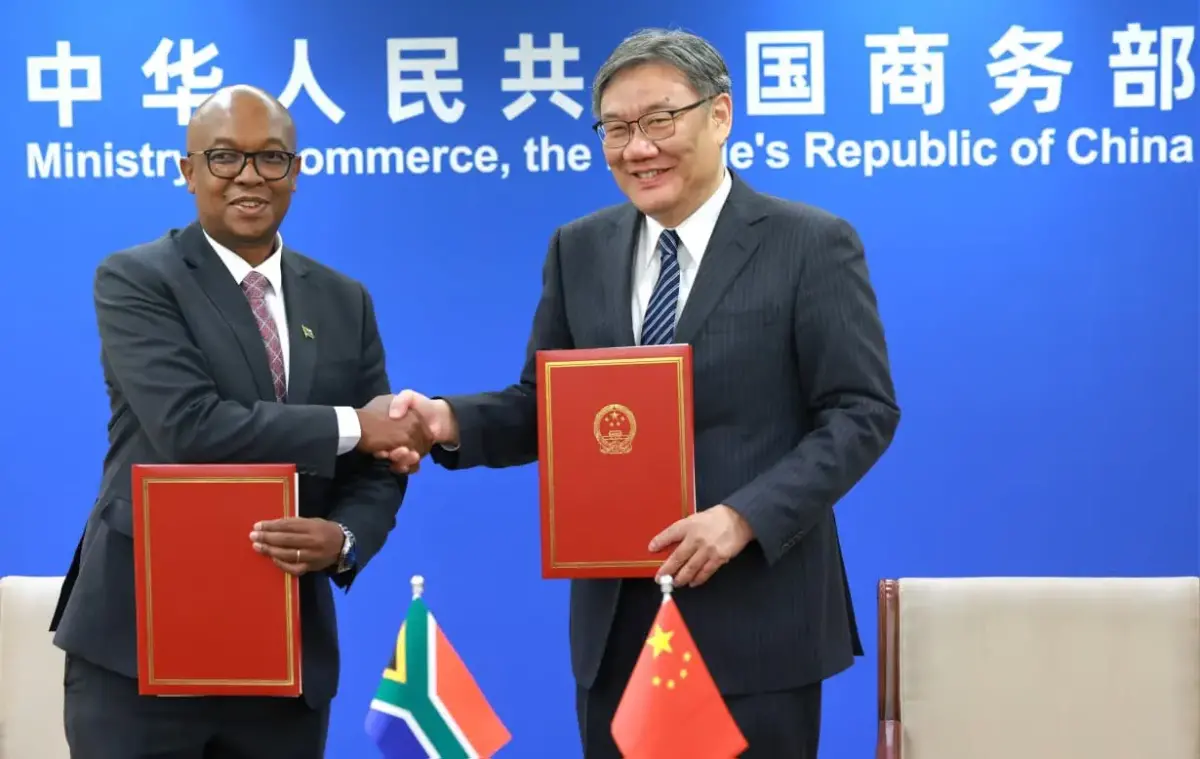
In a move set to rephrase trade dynamics in the Southern Hemisphere, South Africa and China have officially signed a landmark framework agreement that will grant a wide range of South African goods duty-free access to the Chinese market.
The Framework Agreement on Economic Partnership for Shared Prosperity (also referred to as CAEPA) was signed on Friday, 6 February 2026, in Beijing by South African Minister of Trade, Industry and Competition, Parks Tau, and Chinese Minister of Commerce, Wang Wentao. The deal comes at a critical juncture for Pretoria, which is seeking to diversify its export destinations following the recent imposition of 30% tariffs on South African goods by the United States.
Expanding beyond raw materials
While China has long been South Africa's largest trading partner, the bulk of exports has historically been dominated by raw minerals like gold, iron ore, and platinum. This new agreement aims to shift that balance toward value-added products and agriculture.
Key sectors expected to benefit from the immediate duty-free status include:
- Agriculture: Citrus fruits, rooibos tea, and high-quality beef.
- Manufacturing: Processed foods and manufactured components.
- Energy: Collaborative projects in green energy and technology transfer.
“This trip comes at a time when South Africa is pursuing an objective of market diversification,” Minister Tau stated during the ceremony. “We are creating new opportunities in industry-driven sectors that will boost local manufacturing and create much-needed jobs.”
The “Early Harvest” provision
A unique feature of the agreement is the “Early Harvest” clause. Both nations have committed to concluding specific negotiations by the end of March 2026, which will fast-track the removal of tariffs for a priority list of goods. This ensures that South African exporters can begin pivoting toward the Chinese market before the end of the current fiscal year.
Reciprocal investment and safeguards
The agreement is not just about exports. In exchange for market access, China is seeking enhanced investment opportunities within South Africa, particularly in the automotive and steel sectors.
Chinese car brands have already seen their market share in South Africa leap from 2.8% in 2020 to nearly 15% in 2025. Under CAEPA, China will send an “inward buying mission” to South Africa to scout for further investment in local production facilities.
To address concerns regarding the potential displacement of local industries, the South African government confirmed that the framework includes safeguard mechanisms. These provisions allow Pretoria to protect strategic industrial capacity if import surges threaten domestic businesses.
Geopolitical context
The timing of the deal is seen by analysts as a strategic pivot. With the U.S. adopting a more protectionist stance under the current administration, South Africa is leveraging its “all-round strategic cooperative partnership” with Beijing to stabilise its economy.
China, meanwhile, continues to solidify its influence on the continent, positioning itself as a more flexible and “pragmatic” partner for Africa's most industrialised economy.