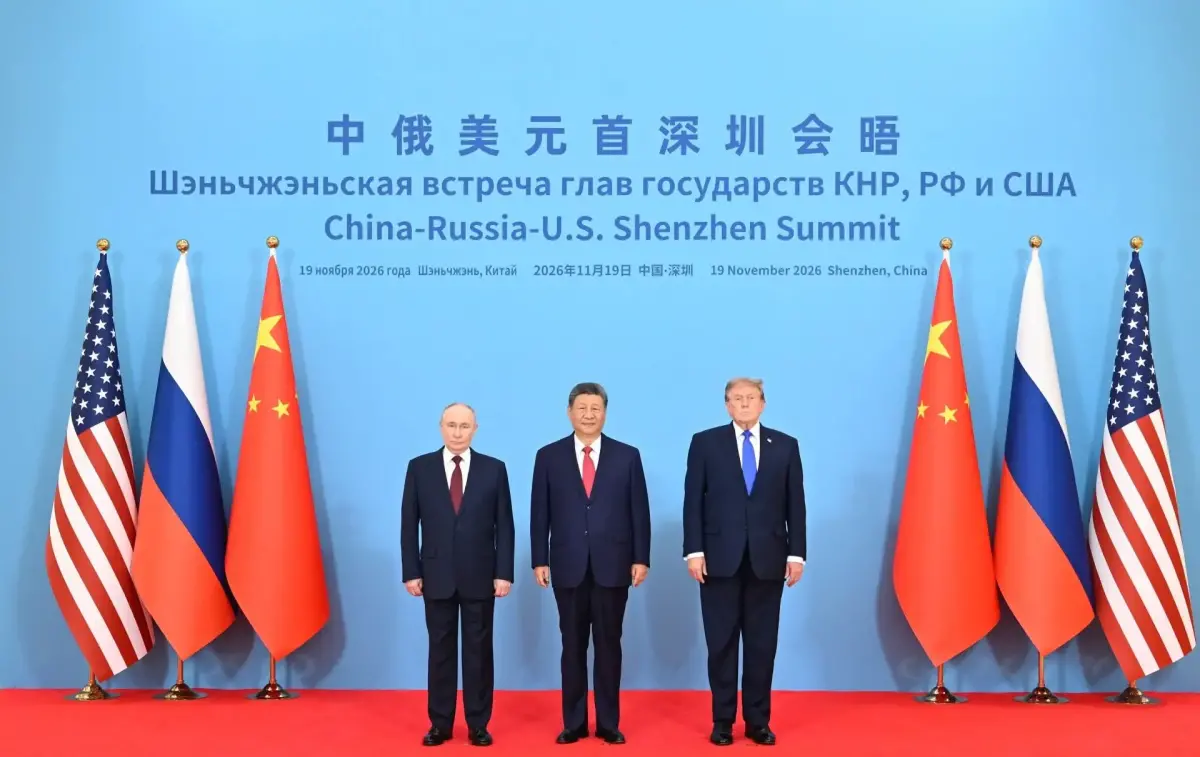
In an unprecedented display of great-power diplomacy, U.S. President Donald Trump, Chinese President Xi Jinping, and Russian President Vladimir Putin convened for a landmark trilateral meeting on the sidelines of the 2026 Asia-Pacific Economic Cooperation (APEC) summit in Shenzhen on Thursday.
Lasting under an hour, the high-stakes sit-down – the first formal trilateral summit ever held among the leaders of Washington, Beijing, and Moscow – concluded with a symbolic joint “peace declaration”. While the three leaders hailed the rare face-to-face engagement as a step forward in global dialogue, the talks yielded no concrete breakthroughs on the world's most pressing crises, including nuclear arms control, the ongoing war in Ukraine, and escalating conflict in the Middle East.
Optics of cooperation amid global friction
Set against the futuristic skyline of Shenzhen – a city Xi Jinping praised at the summit's welcome banquet as a testament to decades of rapid transformation – the event drew intense global scrutiny. Ahead of the trilateral session, Xi personally greeted Trump on the airport tarmac, reciprocating the reception he received in the United States in September, while Trump and Putin shared a publicised handshake before the gathering's formal proceedings.
Opening the talks, Trump declared that the three nations were “really making history,” arguing that peace cannot be achieved by turning down opportunities for dialogue and noting that the three powers are “uniquely positioned” to manage global security. Putin echoed the sentiment, describing the discussions as “open” and “very useful,” while asserting that the three countries share “many converging interests” and a joint responsibility for international stability.
Nuclear arms control takes center stage
A central focus of the closed-door discussions was the future of global nuclear proliferation. The meeting took place nine months after the February expiration of the New START treaty – the last remaining bilateral arms control pact between the U.S. and Russia, which had capped each nation's deployed strategic nuclear warheads at 1,550.
With Trump having previously rejected an extension of the bilateral framework in favor of a new three-way treaty encompassing Beijing, arms control weighed heavily on the agenda. During the talks, Xi called for every effort to prevent nuclear war and reiterated China's stance that nuclear weapons should ultimately be “completely prohibited and thoroughly destroyed.” Despite the rhetoric, however, Beijing – whose nuclear arsenal remains significantly smaller than those of Washington and Moscow – stopped short of committing to formal trilateral disarmament negotiations, and no new treaty framework was announced.
Stalemate on Ukraine and global conflicts
The leaders also touched upon regional conflicts, including Russia's war in Ukraine – now in its fifth year – and the ongoing conflict involving Iran. Putin explicitly referenced Ukraine when highlighting converging security interests among the three powers, yet diplomatic observers noted little sign of tangible movement toward a ceasefire or settlement. Notably, Ukraine was omitted entirely from the joint peace declaration issued following the meeting.
In a striking moment during the proceedings, Trump also took aim at the International Criminal Court (ICC), calling the body “out of control” for overreach – a remark carrying particular weight given the ICC's active arrest warrant against Putin over war crimes charges. Because neither the United States nor China is a party to the Rome Statute, Putin no legal jeopardy traveling to Shenzhen.