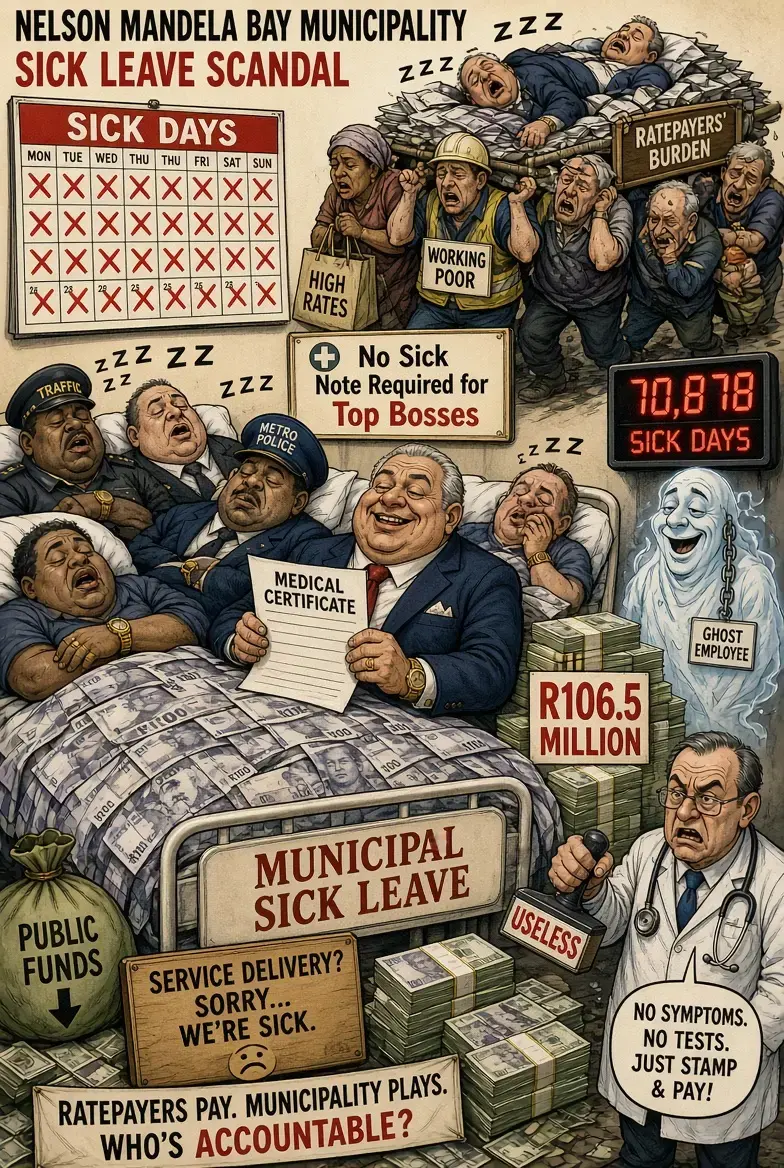
An investigative compilation by the faceless Facebook journalist known as Jan van Riebeeck has drawn sharp public attention to Nelson Mandela Bay Municipality's 2024/25 Annual Report. The report, tabled before Council, reveals that the municipality spent R106.5 million on sick leave in a single financial year, with patterns that mirror fraud-risk indicators previously flagged by the Auditor-General South Africa.
Employees took a total of 70 878.5 sick leave days. That equates to roughly 194 years of work lost in one year, or the equivalent of 283 full-time employees doing nothing for an entire year while still drawing full salaries. The municipality paid out R106 524 640 for those days.
Nearly four out of every five staff members (79%) took sick leave. Of the total days claimed, 35% – more than than 24 800 days – were not backed by a medical certificate. In practical terms, the municipality paid tens of millions of rands for absence that carried no formal proof of illness.
Breakdown by salary band
The bulk of the days and the cost sat with lower- and middle-ranking staff, reflecting their greater numbers. Lower skilled employees in Grades 1-3 accounted for 17 713.5 days at an average of 16 days per employee and an estimated cost of R14.48 million, with 32% of those days uncertified. Skilled levels 3-5 (Grades 4-8) recorded the highest volume at 34 399 days, averaging 15 days per employee and costing R44.53 million, with 34% without certificates. Highly skilled levels 6-8 (Grades 9-13) took 15 876.5 days at an average of 14 days and a cost of R36.1 million, of which 38% lacked medical certificates. Highly skilled supervision levels (Grades 14-18) recorded 2 677.5 days at an average of 12 days and a cost of R9.98 million, also with 38% uncertified.
Senior management (Grades 18-22) showed a different pattern. The 13 employees in this band took only 202 days in total, but at an average of 22 days each – the highest average of any group – at a cost of R1.35 million, with 18% uncertified. The City Manager and Section 56 managers recorded the lowest volume, just 10 days between them at an average of three days and a cost of R86 973. Yet every single one of those days was taken without a medical certificate.
The data reveals a clear pattern: the more junior the employee, the higher the overall volume of sick leave; the more senior the employee, the higher the average days taken and, in the case of the top executives, zero requirement for a doctor's note.
Suspensions and disciplinary cases
Alongside the sick-leave figures, the report records 23 officials either placed on suspension or still on suspension from previous years. Twenty of those matters were finalised in 2024/25. A further 228 disciplinary cases were registered, of which 179 were concluded. Forty-one percent of the disciplinary matters related to absence without leave and sick leave abuse, while insubordination and poor work performance each accounted for 17%. One high-profile example highlighted in the social media investigation is the extended paid suspension of senior officials, including the former City Manager, who remained at home on full salary for a prolonged period.
Red flags and outstanding questions
The combination of high volumes of uncertified sick leave, significant absence-without-leave cases, lengthy paid suspensions, and the sheer scale of the financial outlay mirrors the classic risk indicators that the Auditor-General and National Treasury have repeatedly warned municipalities about: weak leave controls, inadequate verification of medical certificates, and the potential for inflated or ghost absence claims.
Questions now hanging over the municipality include whether original medical certificates exist for the 35% of days taken without them, who authorised the fully uncertified leave of the City Manager and Section 56 managers, what the total cost of keeping 23 officials on paid suspension has been, and whether payroll systems have been checked for duplicate ID numbers, bank accounts, or employees appearing on both permanent and temporary payrolls.
Calls for accountability
Jan van Riebeeck's compilation of the official figures has amplified calls for accountability. The Annual Report itself notes the need for strengthened monitoring, compliance measures and employee awareness regarding sick leave requirements. Ratepayers in Nelson Mandela Bay, already under pressure from service-delivery failures and rising tariffs, will be watching whether that acknowledgement translates into tighter controls – or simply becomes another paragraph in next year's report.