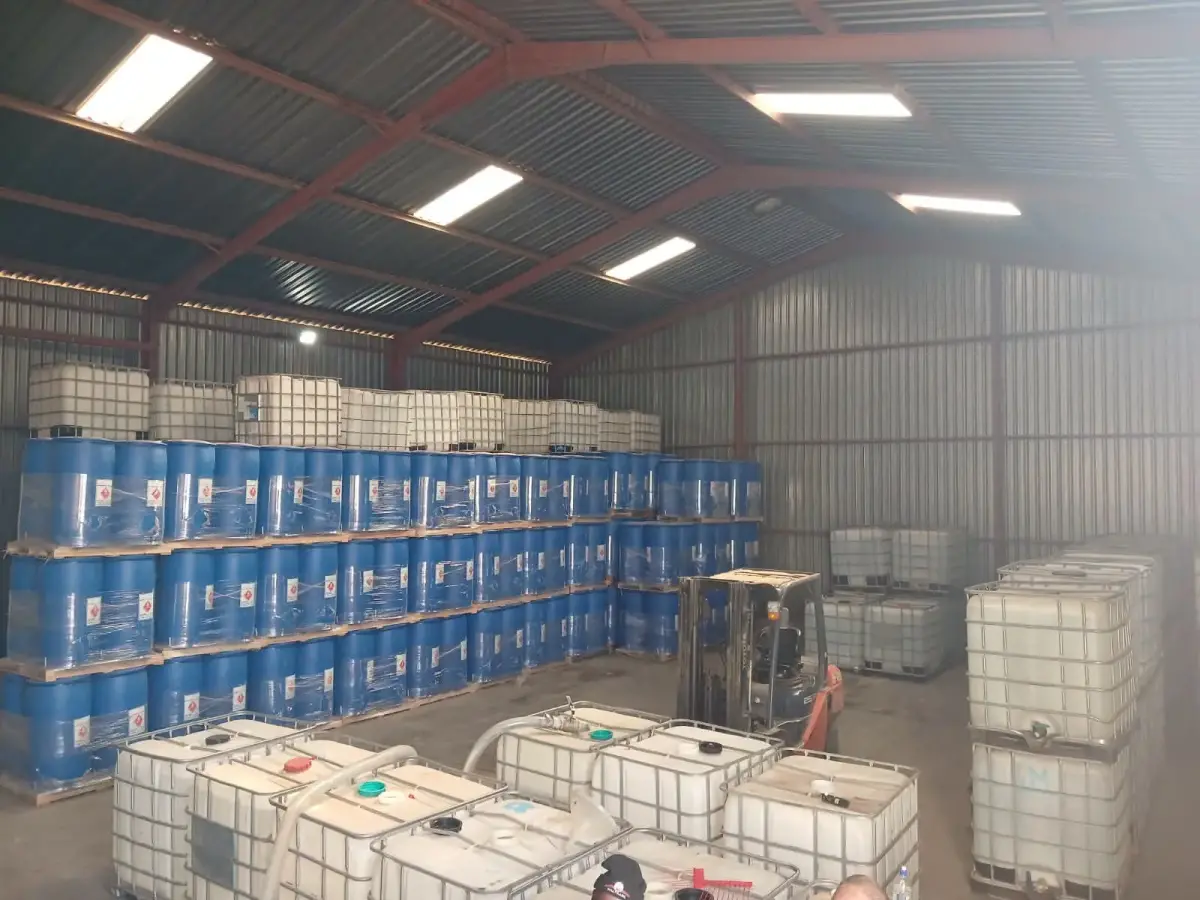
The South African Revenue Service (SARS), in collaboration with the South African Police Service (SAPS) DPCI Serious Commercial Crime Investigations, dealt a major blow to the illicit alcohol trade following a raid on a warehouse in Kempton Park, Guateng.
The targeted enforcement operation took place on Wednesday, 29 July 2026, as part of an intensified crackdown on the illicit economy.
Disguised transit and high-value seizure
Authorities targeted premises identified as a storage facility for imported ethanol with an alcohol content of approximately 96%. The raid occurred as a consignment was being delivered to the warehouse, despite having been declared as destined for a country further north into Africa. The consignment was originally imported by sea and declared to be in-transit, meaning it should have been removed directly through one of Ports of Exit out of South Africa.
Identified as one of four shipments, this specific consignment contained 26,000 litres of ethanol. Because ethanol serves as the base product used to produce liquor products, it generally attracts a duty-rate of R202.84 per litre on the legitimate market. Consequently, the duties and taxes due to SARS for just this single consignment would have totaled around R9.1 million.
Unlicensed storage and suspected quantities
Upon arrival, the joint team discovered the consignment being off-loaded at an unlicensed and unregistered facility into 1,000-litre flow-bins. The site also housed several other flow-bins and storage tanks containing a suspected additional 28,000 litres of ethanol, the contents of which are subject to further testing.
Commissioner remarks and broader impact
SARS Commissioner Dr Johnstone Makhubu expressed satisfaction with the operation, highlighting that it forms part of broader government efforts to combat illicit economic activities and enhance compliance in critical sectors.
He emphasised that the illicit alcohol trade is not a victimless crime, as it deprives the country of essential public service revenue, undermines compliant businesses through artificially low prices, and poses severe health risks to consumers via substandard liquor quality.