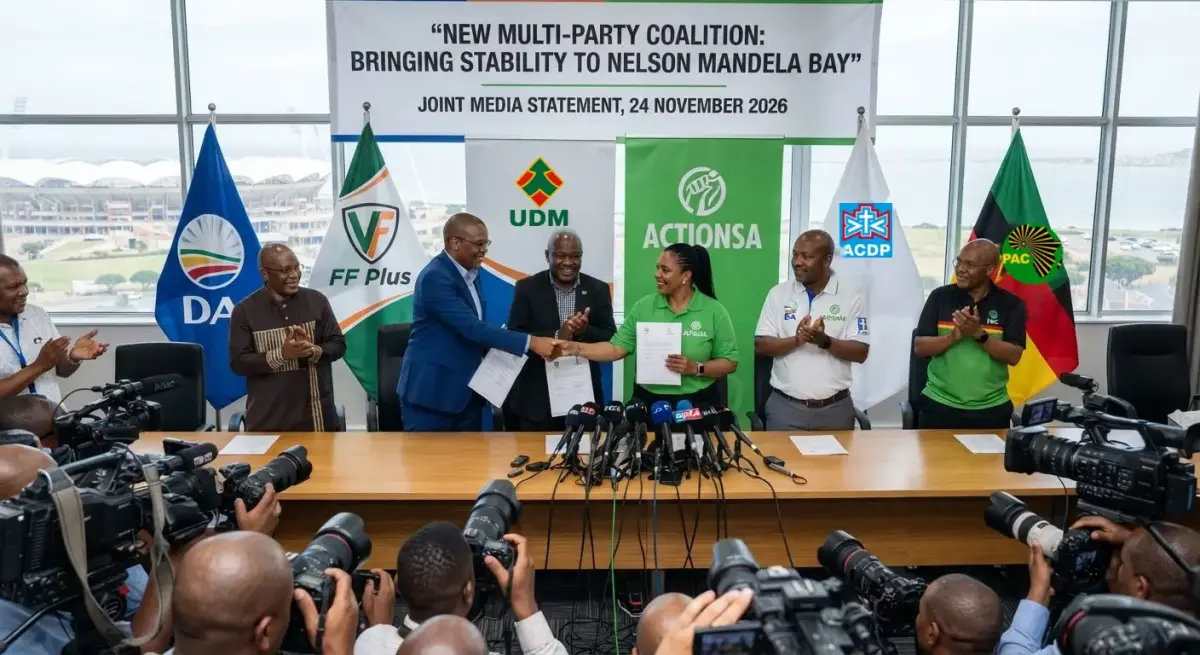
Six political parties have officially joined forces to form a new multi-party coalition government in Nelson Mandela Bay, pledging to end years of administrative instability and restore basic service delivery across the metro.
In a joint media statement issued today, 24 November 2026, the Democratic Alliance (DA), Freedom Front Plus (FF Plus), United Democratic Movement (UDM), ActionSA, African Christian Democratic Party (ACDP), and Pan Africanist Congress (PAC) confirmed that their respective leaders signed the formal coalition agreement yesterday, 23 November.
Together, the six partners command 63 of the 120 council seats – surpassing the 61-seat threshold required for an outright majority following the recent local government elections, where the DA emerged as the largest party with 53 seats.
Opposition parties left in the cold
The formation of this six-party bloc effectively sidelines 12 other parties represented in the Nelson Mandela Bay council, relegating them to the opposition benches. Chief among those left out of the governing arrangement is the African National Congress (ANC), which holds 32 seats and previously led the outgoing coalition administration.
Other notable parties excluded from the executive agreement include the Economic Freedom Fighters (EFF) with seven seats, the South African Communist Party (SACP) with four seats, and the Patriotic Alliance (PA) with four seats. Also left in the cold are the uMkhonto weSizwe (MK) Party (two seats) and the Mayibuye Civic Movement (two seats), alongside six single-seat parties: the African Independent Congress (AIC), African Transformation Movement (ATM), National Alliance (NA), Democratic Movement, Afrika Mayibuye Movement, and the United Progressive People Alliance (UPPA).
Addressing systemic governance failures
The newly formed alliance acknowledged that residents and local businesses have borne the brunt of unstable municipal leadership, which has resulted in failing water and electricity supplies, raw sewage flowing through streets, and neglected infrastructure maintenance. Describing the pact as a vital change of government, the coalition stated that its primary objective is to fix these systemic failures.
Commitment to five-year stability
Drawing lessons from the collapse of previous coalition arrangements in the metro, the six parties emphasised a commitment to governing together for the full five-year term. According to the statement, long-term continuity is essential to allow the municipality to properly plan budgets, clear maintenance backlogs, and see major infrastructure projects through to completion.
The parties have agreed to use their coalition framework to resolve internal differences and share joint responsibility for difficult governance decisions, ensuring every partner contributes equally regardless of party size.
Immediate service delivery and financial priorities
Upon taking office, the coalition's immediate priorities center on stabilising water and electricity networks, addressing sewage spills, and getting routine municipal maintenance back on track. Alongside infrastructure recovery, the leadership intends to enforce strict financial discipline, root out corruption, and open municipal spending and procurement processes to public scrutiny.
By keeping basic infrastructure functional and making it easier to do business, the municipality aims to give local employers the confidence to invest and create jobs.
Rebuilding public trust
To earn back public trust, the coalition pledged to serve every resident across every ward, ensuring communities receive clear updates on completed repairs, project delays, and active recovery plans. Operating on principles of mutual respect, consultation, and ethical leadership, the six-party coalition seeks to turn a new page for Nelson Mandela Bay by placing the interests of its residents at the forefront of local governance.