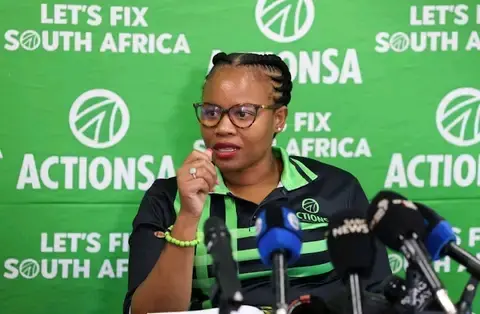
Following weeks of high-stakes coalition negotiations after the 4 November 2026 local government elections, ActionSA's Dr Nasiphi Moya has returned to lead South Africa's administrative capital as Executive Mayor of the City of Tshwane. Her re-election during the sixth-term inaugural council sitting at Tshwane House on Thursday, 26 November 2026, secures a full five-year mandate for the leader who first stepped into the role in October 2024.
The coalition math behind the return
The 4 November municipal polls left the 214-seat Tshwane council hung, with no single party winning an outright majority of 108 seats. While the Democratic Alliance (DA) emerged as the largest individual party with 74 seats (34.37% of the vote), ActionSA significantly expanded its footprint to become the second-largest party with 48 seats, followed by the African National Congress (ANC) with 44 seats.
To form a working majority and keep the DA on the opposition benches, ActionSA forged a multiparty coalition agreement with the ANC, the Economic Freedom Fighters (EFF, 13 seats), and the uMkhonto weSizwe (MK) Party (4 seats). Together, the bloc commands 109 seats – just above the required threshold. Under the power-sharing arrangement, Dr Nasiphi Moya of ActionSA retains the position of Executive Mayor, while the ANC's Naeem Patel serves as Council Speaker and the EFF's Omphile Maotwe steps in as Deputy Mayor.
From stabilisation to a full mandate
Dr Moya, who holds a PhD in Political Studies from the University of the Western Cape and previously served as Tshwane's Deputy Mayor, first took over the mayoral chain in October 2024 following the ouster of the DA's Cilliers Brink.
Over the past two years, Moya built her political brand around visible, hands-on governance – frequently emphasising direct community outreach over boardroom meetings and campaigning on a platform to move Tshwane “from stabilisation to restoration”. ActionSA leadership made securing another five years for Moya a non-negotiable red line during post-election talks across Gauteng metros, arguing that local government success depends on practical service delivery rather than rigid ideological alignment.
The road ahead for the capital
While the coalition deal provides political continuity at Tshwane House, Moya's incoming administration faces steep operational and financial hurdles. According to municipal financial health assessments and the city's Integrated Development Plan, her top priorities over the next five years centre on three core areas.
First is infrastructure maintenance, which requires addressing persistent water shortages, ageing electrical grids, and low capital expenditure on road and pipe repairs. Second is financial governance, focused on reining in unauthorised, irregular, fruitless, and wasteful expenditure while improving the city's audit outcomes. Finally, the administration must master coalition management, carefully balancing the competing policy demands of four distinct political parties to prevent the council instability that has historically plagued Gauteng's metros.
With the inaugural council formalities complete, residents across Pretoria and its surrounding townships will be watching closely to see whether Moya's renewed mandate translates coalition arithmetic into reliable basic services.