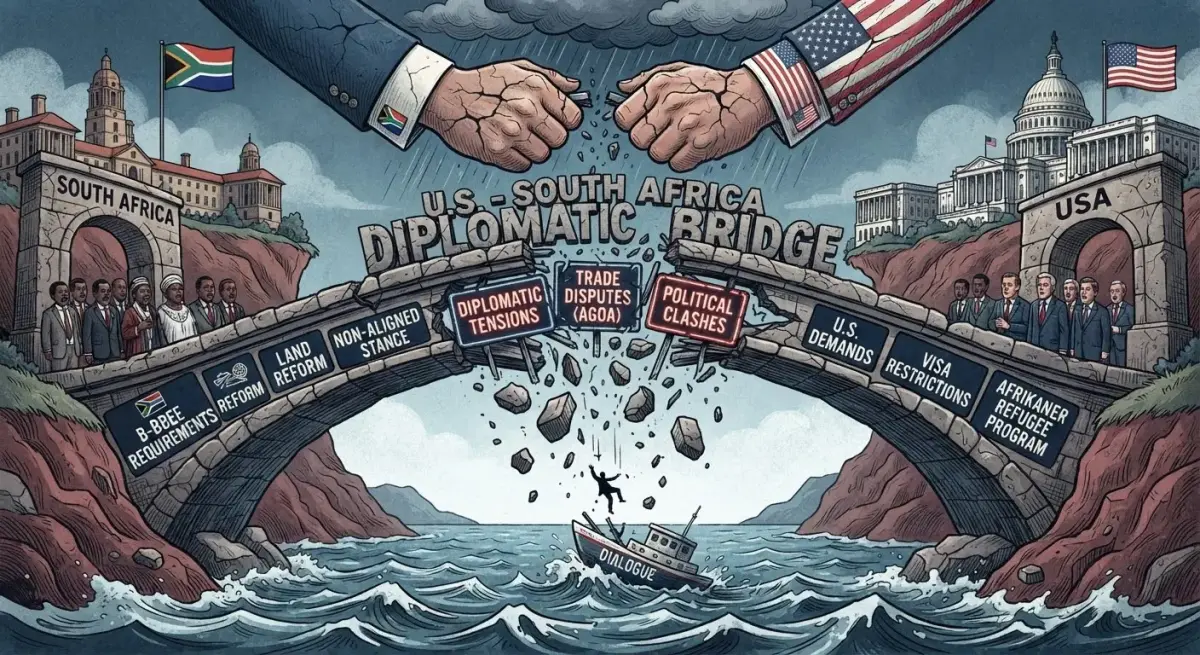
Tensions between South Africa's Department of International Relations and Cooperation (DIRCO) and the United States ambassador to Pretoria have escalated sharply in 2026, marked by three formal diplomatic protests – known as demarches – issued against Ambassador Leo Brent Bozell III in under nine months. The latest, delivered around 29-30 September 2026, underscores a broader deterioration in bilateral relations under the second Trump administration.
Background and key flashpoints
Bozell, a conservative activist and writer, arrived in South Africa in February 2026 and was formally accredited in April. His tenure has been defined by public criticism of South African policies that Washington views as problematic, set against Pretoria's insistence on sovereignty and its non-aligned foreign policy.
The first demarche came in March 2026. Bozell publicly dismissed a South African court ruling that the “Kill the Boer” chant did not constitute hate speech, stating he did not care what the courts said and labeling it hate speech. DIRCO viewed the remarks as undermining the judiciary and historical context. Bozell later apologised, and the U.S. mission issued a public expression of regret.
A second rebuke followed in June after Bozell criticised Pretoria's engagement with countries Washington considers adversaries – specifically around South Africa hosting Iran's deputy foreign minister and high-level contacts with China. DIRCO responded that non-alignment should not be mistaken for neutrality and noted the inconsistency of criticising engagement with states the U.S. itself deals with.
The third and most recent demarche, confirmed by a senior DIRCO official, cited “undiplomatic conduct.” It followed a series of media interviews and an op-ed in which Bozell accused the South African government of failing to meaningfully address U.S. concerns, of rejecting a constructive relationship, and of testing American patience. The timing coincided with U.S. Secretary of Marco Rubio's announcement of targeted visa restrictions on certain South African officials linked to uncompensated land seizures, race-based policies, or alleged incitement against minority groups.
The “Five Asks” and underlying disputes
At the core of the friction are a set of U.S. demands (often referred to as the “five asks”) presented to Pretoria. These centre on exemptions or alternatives for U.S. companies from Broad-Based Black Economic Empowerment (B-BBEE) requirements, particularly in mining and telecommunications; opposition to expropriation of land without compensation; condemnation of the “Kill the Boer” chant; stronger action on rural crime and farm murders; and non-interference with a U.S. programme offering refugee status to white Afrikaners whom the Trump administration claims face persecution.
South African officials and lawmakers reject these as interference in domestic affairs. Government policies on land reform and economic transformation are framed as necessary redress for apartheid-era inequalities. White South Africans remain, on average, wealthier and more employed than Black South Africans; Pretoria argues that framing the situation as systemic persecution of whites is false.
President Cyril Ramaphosa met Bozell in August 2026, and a formal written response to the U.S. demands was later provided. Washington described the reply as inadequate on key points; Pretoria maintains it engaged constructively. The U.S. State Department responded to the latest demarche by stating that Ambassador Bozell had gone to DIRCO to discuss the bilateral relationship, that the U.S. seeks clarity rather than “diplomatic manoeuvring or dialogue for dialogue's sake,” and that “the ball is now squarely in the Government of South Africa's court.”
Latest exchange: Lamola's remarks and Bozell's response
The dispute intensified further over the weekend. In comments reported by the Sunday Times on 4 October 2026, International Relations and Cooperation Minister Ronald Lamola said he was “taken aback” by Bozell's earlier suggestion that the time for talking was over. Lamola stated: “You can't have a diplomat who says the time for talking is over. It's our job to talk. So if you can't talk as a diplomat and you cannot dialogue… get out of the kitchen.” He also accused the ambassador of interfering in South Africa's domestic politics.
Bozell responded the same day on X(@USAmbRSA), writing: “So here we go again.Another Minister Lamola personal insult aimed at an American leader (this time me) which, when denounced (which I'm doing now), will result in a demarche with a lecture about being ‘undiplomatic.’ And then the South African government wonders why relations are collapsing.”