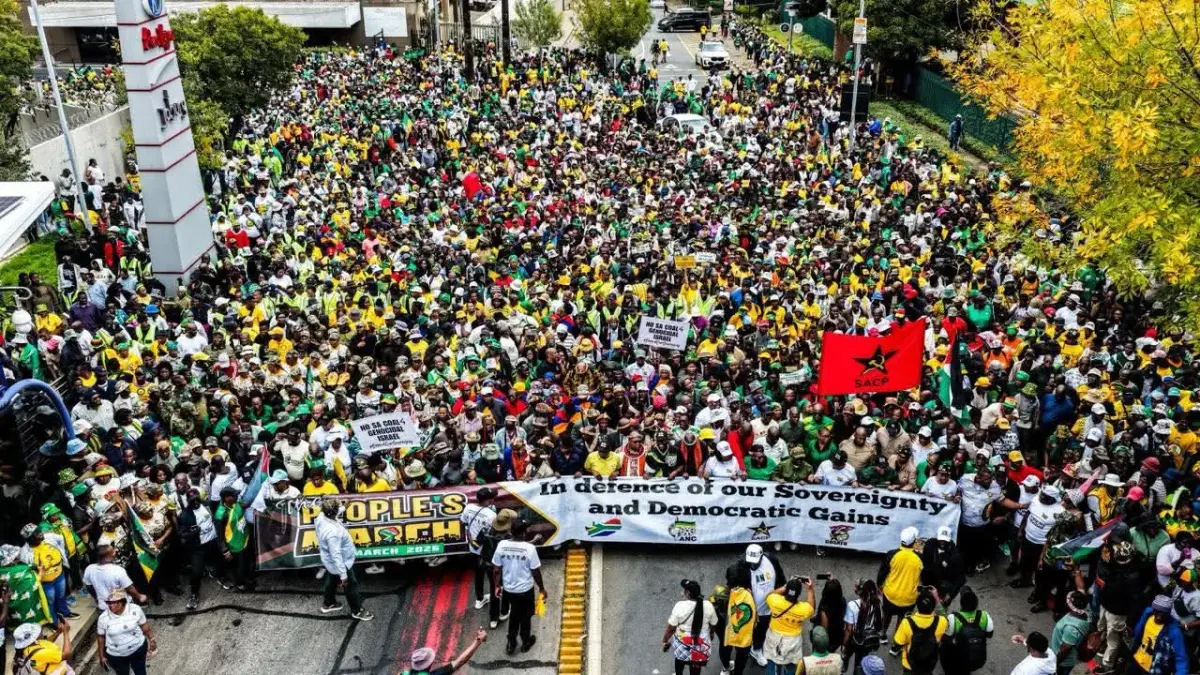
In a massive show of political force and national unity, thousands of South Africans took to the streets yesterday, 21 March 2026, for the “People's March in Defence of Our Sovereignty and Democratic Gains.”
The march was organised by African National Congress (ANC) and its Tripartite Alliance partners – COSATU, the SACP, and SANCO – the march coincided with Human Rights Day, marking a high-stakes moment for the country's 30th year of constitutional democracy.
A sea of green, gold, and black in Johannesburg
The main event unfolded in Johannesburg, where a vibrant “sea of ANC colors" stretched from Mary Fitzgerald Square in Newtown, across the iconic Nelson Mandela Bridge, and ended at Constitutional Hill.
The atmosphere was charged with songs of struggle and modern chants as marchers – ranging from workers and youth to traditional leaders and religious groups – converged on the Constitutional Court.
Key themes: “No Bullying” and Sovereignty
The 2026 march was uniquely framed by rising international tensions and perceived external interference in South Africa's domestic policies. Speakers at Constitution Hill, including Minister of International Relations Ronald Lamola, delivered a firm message: South Africa will not be “bullied” regarding its foreign policy or internal transformation laws.
- Defending Sovereignty: Leaders emphasised that South Africa's commitment to Broad-Based Black Economic Empowerment (B-BBEE) and land reform remains non-negotiable despite pressure from foreign administrators.
- Constitutional Pride: The march celebrated the 30th anniversary of the Constitution, with leaders receiving a memorandum of grievances and affirmations on the steps of the highest court.
- Global Tensions: The event served as a platform for the ANC to advocate for an independent, non-aligned foreign policy amidst shifting global alliances and conflicts.
Simultaneous action across the provinces
While Johannesburg saw the largest turnout, the “People's March” was truly national in scope. Significant gatherings of South Africans were held in:
- Cape Town: Thousands marched to Parliament to highlight economic rights and sovereignty.
- eThekwini (Durban): Solidarity walks focused on the protection of democratic institutions.
- East London: Regional leaders addressed local labour and land issues within the framework of the national struggle.
Reflecting on the past
By holding the march on 21 March, the ANC intentionally linked modern political challenges to the legacy of the Sharpeville Massacre(1960). Leaders noted that while the “pass laws” are gone, the struggle to protect the dignity and self-determination of South Africans continues in a new, globalised theatre.
“On the 21st of March, the people of this country rose not in disorder, but in disciplined formation; not in anger, but in purposeful resolve.” – ANC Secretary-General Fikile Mbalula.