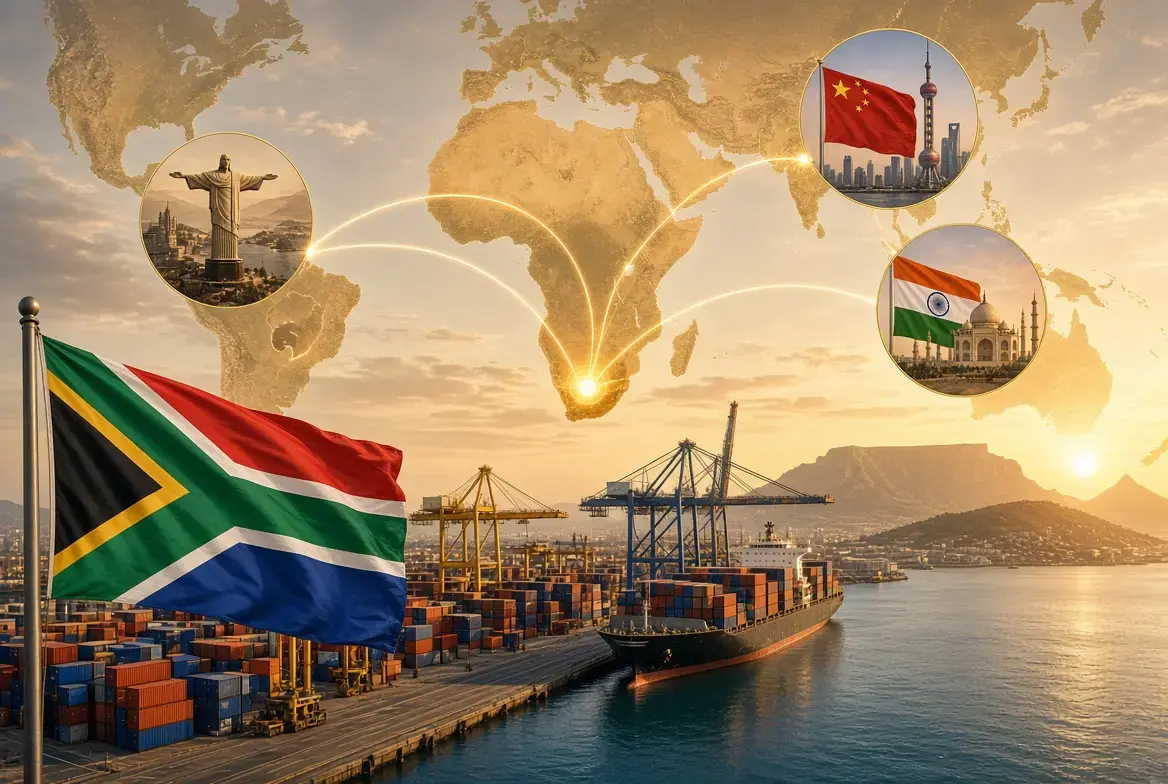
The United States' decision to terminate South Africa's preferential access under the African Growth and Opportunity Act from 1 January 2027 marks a significant shift in bilateral trade relations. Announced by the Trump administration after an eligibility review, the move cites concerns over barriers to US trade and investment, corruption, and national security and foreign policy interests.
South Africa, long the largest beneficiary of the programme, exported $1.7 billion (R28.3 billion) in goods under AGOA in 2025 – mainly automotive components, citrus, wine and other agricultural products – representing about 10 percent of its exports to the United States and just 1 percent of its total global exports.
While the immediate impact will be felt in specific sectors and communities, particularly citrus growers in the Western and Northern Cape and parts of the automotive value chain, this development is not an existential threat to the broader economy. Most South African exports to the United States already enter under ordinary World Trade Organisation most-favoured-nation terms. Bilateral trade reached $28.8 billion (R479 billion) in 2025, and more than 600 American companies continue to operate in South Africa, supporting over 134,000 jobs. The government has rightly stated that the door to the United States remains open and that it will support affected industries during the transition.
Yet the real opportunity lies in treating this moment as a catalyst rather than a crisis. South Africa must accelerate the diversification of its export markets and deepen trade and investment relations across the Global South. This is not about turning away from traditional partners, but about building greater resilience in a multipolar world where economic partnerships are increasingly shaped by shared development priorities rather than unilateral preferences.
China offers immediate market access
China, already South Africa's largest trading partner, offers immediate and tangible alternatives. Beijing's temporary zero-tariff scheme for qualifying African exports, introduced in May 2026, has already delivered results. Bilateral trade expanded by nearly 24 percent year-on-year to almost $15 billlion (R249.5 billion) in recent periods, with South African exports to China arising nearly 25 percent to $5.3 billion (R88.1 billion) and agricultural shipments up more than 35 percent.
Minister of Trade, Industry and Competition Parks Tau has urged businesses to maximise this duty-free access while negotiations continue toward longer-term frameworks, including a China-Africa Economic Partnership for Shared Development and potential SACU-China early-harvest arrangements.
India and the potential of preferential trade
India presents another high-potential market of 1.4 billion consumers. Talks on a preferential trade agreement between SACU and India, stalled for a decade, have been revived. South Africa currently runs a trade deficit with India, exporting mainly coal, manganese and chemical wood pulp while importing petroleum, vehicles, pharmaceuticals and machinery. Closing this gap through higher-value exports, joint ventures in advanced manufacturing, pharmaceuticals, agro-processing and renewable energy, and greater use of the African Continental Free Trade Area as a platform for Indian investment into regional value chains, should be a priority.
Deepening BRICS and Latin American ties
Within BRICS+, South Africa can push for more ambitious economic cooperation. The grouping's expansion has increased its collective weight, yet intra-BRICS trade remains underdeveloped relative to members' external trade. Deepening agricultural trade, reducing tariffs and non-tariff barriers, and leveraging the New Development Bank for infrastructure and industrial projects would help convert political solidarity into commercial gains.
Brazil, as South Africa's largest trading partner in Latin America, offers further scope through the existing SACU-MERCOSUR Preferential Trade Agreement and opportunities in pharmaceuticals, mining, automotive and critical minerals beneficiation.
The strategic role of the African Continental Free Trade Area
Closer to home, the African Continental Free Trade Area remains the most strategic long-term lever. A fully implemented continental free trade area of more than 1.4 billion people provides the scale needed to industrialise, build regional value chains and reduce dependence on any single external market. South Africa's industrial development strategy already identifies opportunities across Africa, ASEAN, MERCOSUR and other emerging markets. New market access for citrus, avocados, grapes and apples demonstrates that progress is possible when focused diplomatic and commercial efforts are applied.
Building resilience through concrete action
Capitalising on these opportunities requires concrete action. Government and business must work together to secure long-term, reciprocal trade arrangements that provide certainty beyond temporary preference schemes. They must invest in logistics, phytosanitary compliance and quality systems that meet the standards of diverse markets, particularly in Asia. Affected sectors such as citrus, wine and automotive components need targeted support while being facilitated toward new buyers.
Promoting beneficiation of critical minerals and higher-value manufacturing will allow South Africa to export more processed goods rather than primary commodities. Constructive engagement with the United States on the broader commercial relationship, including investment and critical minerals supply, should continue even as preferential tariff access ends.
The loss of AGOA preferential treatment is a reminder that unilateral trade privileges can be withdrawn. It is also a reminder that South Africa's long-term prosperity depends on diversified, mutually beneficial partnerships rooted in the Global South's growing economic weight. By treating the current disruption as an inflection point, Pretoria can strengthen its position in the emerging multipolar trading system, project jobs through new market access, and advance industrialisation on terms that serve national and continental interests.
The window is open. South Africa must move decisively to walk through it.